Wednesday, November 30, 2011

Saint Apostle Andrew


The Apostle of the Romanians

St. Andrew represents for many Christians one of the most important saints in the year. That happens, as an example in Romania, where in the last 20 years almost a half of the born children were baptized with the name of this saint. That happened, because of the popularizing of his cult: there is believed that the Apostle Andrew is the first one who preached the Gospel on the territories near the Black Sea. He is also considered the founder of the Church of Byzantium and is consequently the patron saint of the Ecumenical Patriarchate of Constantinople. In this way, providentially, the two brothers Peter and Andrew are the patron Saints of the Western Catholic Church, respectively of the Eastern Orthodox Church.

The life of St. Andrew

About the Saint Andrew is not very much to know from the Gospels. Being born in the eastern Galilee, at the shore of the Genezareth Sea, in the little fishermen-town of Betsaida, probably he raised into a cosmopolite society. His name is coming from Greek, ἀνδρεία (“andreia”) meaing the virtue of the “brevity”, “manhood”, or “valour”.

From the New Testament we may know that Andrew was the brother of Simon Peter, both sons of Jonah (Mt. 16:17, Jn. 1:42). Both he and his brother Peter were fishermen, and our Lord Jesus called them to be his disciples by saying that he will make them "fishers of men" (Mt. 4, 19). The Gospel of John states some more details: Andrew was a disciple of John the Baptist, who adviced him to follow Jesus.(Jn. 1:35-40). In the same text it is shown that Andrew is the one who first recognized Jesus as the Messiah, introduced Him to his brother (Jn. 1:41), that’s why in the Eastern Churches he is named “Andrew the First called to the Apostolate”. Sometimes Andrew is one of the closer companionship of Jesus, though generally the small group is formed only by Peter, John and Jacob. Other things are not known about St. Andrew until the Resurrection of Our Lord and his Ascension.

Although not mentioned in the Acts of the Apostles, the missionary journeys of the Apostle Andrew are known for the Christian believers from several accounts of the Church Fathers. Eusebius of Caesarea, taking a tradition from Origenes (Church History III, 1), mentioned Scythia as the main place of his mission, and St. Gregory of Nazianzus (in the 33th Homily) mentions the land of Epirus. St. Jerome in his Epistle to Marcel mentions Achaia, and Theodoret of Cyrus (in the commentary on Psalm 116) reminds generally Greece. In addition, Nikephoros (in his Ecclesiastical History II, 39), based on an earlier work (which he mentions without naming it punctually), says that the Saint preached in Cappadocia, Galatia and Bithynia, then in the wilderness of Scythians, at that time inhabited by cannibals and later in Byzantium, where he ordained Stachys as the first bishop, then continued preaching in Thrace, Macedonia, Thessaly and finally in, Achaia.

According to the tradition, St. Andrew's martyrdom took place during the reign of Nero, on 30th November in the year 60, and he is celebrated on this day both in the East and the West.

The Legend Aurea, a work compiled by the Bishop James of Voragine of Genoa (XIIIth century), mentions that St. Andrew was nailed to a cross shaped in X-form (also called “Crux decussate” or “saltyra”), at the order of Aegeas, the governor of Patras, because he has refused to sacrifice to the gods. In the history, St. Andrew explains in details the meaning of the “foolish” sacrifice of Christ on the Cross.

While being crucified, the saint preached the Gospel to the people who surrounded him, and after two days it came down from Heaven a great light, so nobody could see what happened with him for a half an hour. Together with this light, the soul of St. Andrew ascended to the Heaven. After his martyrical death, Maximilla, Aegeas’ wife, who was already Christian, took the Apostle’s body and buried him with honor. According to the legend, the tomb of St. Andrew emanated manna and nice smelling myrrh. When from the grave came only a few manna, the land gave less crop, and when manna came in abundance, the earth gave also more crop to the landworkers.

The History of the Relics

The Relics of the First-Called among the Apostles remained in Patras until 357, when Emperor Constantius II, son of Constantine the Great, took and placed them in the Church of the Holy Apostles in Constantinople. They were kept whole until around 850, when the Byzantine Emperor Basil I the Macedonian at the prayers of the peoples from Patras sent them a holy reliquary with the head of the saint.

In 1453 Thomas Palaeologus, Ruler of Morea (Peloponesus) and brother of the last Byzantine emperor (Constantine IX), refuged to Rome because of the Turkish danger, and took the holy relics from Patras (the head, a finger, and part of the cross), giving them as gift to the Pope Pius II, in the memory of the fact that Peter and Andrew were brothers. They were kept in a reliquary at Pienza, and later, in the dome of San Pietro. Pope Pius II received them, promising to send them back to Greece, where the country will be released by the Turks.

Another Italian tradition claims that immediately after the Fourth Crusade, in 1208, the Cardinal Peter of Capua took the remnant holy relics from Constantionople and brought them in Amalfi, near Naples, some part of them being kept until today in the dome of San Andrea. From here, Pope Pius II would have been taken them, because of the Turkish danger in 1460, and gave them to the St. Peter's Cathedral in Rome, leaving only a few particles in Amalfi. Today in Amalfi is stored also the sarcophagus in which were relics of the saint.

In 1964 Pope Paul VI decided, during the third session of the Second Vatican Council, to offer back as gift the head of the Saint, to the Holy Church of Patras, as a sign of brotherly love. The Head of the Saint is here since September 26, 1964. A small part of the relics remained also in the cathedral of San Pietro.

A Western tradition claims that Bishop Acca of Hexam brought in the 8th century a piece of the relics of St. Andrew in Scotland, and soon Andrew was considered the patron saint of this country. The relics were preserved in the cathedral from St. Andrews until the Reformation, when once the destruction of the cathedral, they were lost. In 1879 and 1969 it have been brought in Scotland some small relics from Amalfi, which are kept in the Cathedral St. Mary in Edinburgh.

Other relics of Saint

St. Andrew’s apostolic mission continues today through His relics, which are venerated by the Christians in various parts of the world.

The Relics from Patras were brought in Romania twice, in 1996 in Iasi and Galati, and in 2011 in Bucharest and Sibiu, and particles these relics were donated to the cathedrals of Galati and Constanta. In the East, particles of the relics are kept also in the Russian skete of St. Andrew from Mount Athos, in the Russian Cathedral in Chelyabinsk (1884), the church of Gabrovo (Bulgaria), St. Andrew Church in Mesa Geitonia (Cyprus), Tbilisi (Georgia), and in the Orthodox cathedral in Astana (Kazakhstan).

In the West, other reliquaries with the relics of the saint are found in Trier (Germany), in the Monastery of Santa Chiara in Naples, the church of Casino di Cicco Sant'Apollinare (between Rome and Naples), the churches of St. Andrew in Warsaw and Szaflary (near Krakow), the church of Saint Lupicin (in the Jura Mountains, France), the church of San Pedro de la Rua (Estella, Basque Country), in Mehrba (Malta) and, since 2006 also in the Catholic Cathedral from Hong Kong. A small particle there is found in the Romanian church in Vienna.

Patron Saint in many countries

St. Andrew is the patron of Scotland (Scottish flag is the cross of St Andrew), of Spain, Sicily, Greece, Russia, Ukraine and Romania. He is also the patron of the cities: Naples, Ravenna, Brescia, Amalfi, Mantua, Bordeaux, Bruges, Patras and Galati, my hometown.

Popular Traditions of St. Andrew

In the Eastern Europe is the Night before the Holiday of St Andrew (29/30 November), especially in the villages, one of the most important in the year. St Andrew was believed to be the protector against the evil spirits who are coming together with the winter time.. In some villages the peoples practice some rituals similar to the ones of the Western Halloween. For instance, today in Galati, a Romanian city protected by St. Andrew, there is organized a carnival which reminds of the old awful masks used, in order to scare the ghosts. Also there is still practiced the custom of hanging garlic near the doors and windows and to make pumpkin lanterns and pumpkin cakes in this day, because there is believed that, in this night, the ghosts and the wolves are haunting the streets. Also the landworkers put basil (a sacred plant) and holy water in the drinking water of the cattle, in order to protect them by the attacks of the wolves. They also sing in this evening some special carols, similar to the Christmas carols.

The Night of St. Andrew is also a “prognosis” for the whole year. Usually, in this day there are put in the attic 12 healthy onions, which are left there until the Christmas Eve, when they are checked. Each onion is assigned the name of a month, and the onions that have been damaged indicate rainy months, during those that have sprouted - the months of a favorable harvest. A similar prediction, about the fate of the harvest is done using wheat berries. Also if the night is clear and warm, it is believed that the winter won’t be cold. If it's cold and snow, it is believed that these are the beginnings of a harsh winter.

The old Romanian name for December is “Andrea”, by the belief that the Saint will protect the people until the smallest day in the year.

All those pagan customs show the importance of this Saint in the Calendar and, before being interpreted as some barbaric customs, they show that the simple believers hoped to be protected by the Saint against the bad things.

The Hymn (Troparion) of St. Andrew:

“As the first-called among the Apostles and brother of their leader, O Andrew, intercede with the Master of all to grant peace to the world, and to our souls great mercy.”

Friday, November 11, 2011

Saint Paisie Velichkovski from the Monastery of Neamţ

- The Father of the Romanian "Filocalia" -

Saint Paisie from the Monastery of Neamţ (today in northwestern Romania) is a saint revendicated equally by the Slavic and the Romanian Orthodoxy, for his contribution to the “Orthodox Renaissance”, in the late 18th century. His name is transliterated in Romanian as Paisie Velicicovschi, and in Ukrainian as Паїсій Величковський.

The revendication of a saint is not a priviledge, but an inheritance of a spirituality which both Romania and Ukraine (or maybe all the Slavic-speaking countries) have it fully until today.

The first years

Saint Paisius, as a laymen named Peter, was born in born in Poltava, Ukraine on 21 December 1722, in a priestly family, being the eleventh child of twelve. His father, John, was the dean-priester in the diocese, and his mother, Irene, was a very pious Christian woman.

His father died very early and the whole education given by his mother was crowned in 1735, when the child was sent to learn at the Theological Academy of Kiev, founded by the Bishop Peter Movilă, an important orthodox bishop in the late Middle Ages, the author of the Orthodox Confession of Faith from 1645. After four years of study, the young Peter left the school and entered in the community of the Medvedeski Monastery, being 19 years old. Here he was tonsured as rasofor (bearer of “rasa”, a monastic cloth: practically a novice), receiving the name of Platon. After a short stay in the monastery Pecerska, he came in Wallachia in 1745, at the skete Traisteni, near Ramnicu Sarat and then to Dălhăuţi Monastery (southern Moldova).

The Monastic life and the work of translation

In the summer of 1746 he went to Mount Athos, where he tried the life as a hermit, for 4 years. Only after that hewas tonsured as monk, in 1750, having as “godfather” his confessor, a Moldavian monk, St. Basil of Poiana Marului, taking then the name of Paisie (Paisius). Shortly after he was ordained as hieromonk (priester-monk), and he founded the monastic community of the Holy Prophet Elias. He wes gathering around him about 65 Romanian monks, and by summer 1763, he left Mt. Athos, because of the financial claimings of the Turks. So, Paisius and his community came back in Moldova and all established themselves at the monastery of Dragomirna, near the old capital, Suceava.

The community of Paisius at Dragmirna has grown there to 350 monks. His success consisted in the popularization of some important mystical works, by translating them in the local languages. Paisius himself and some disciples translated for the first time the “Philokalia” (“the love for beauty”), a kind of manual of spirituality of the Eastern Churches, from old Greek to Romanian and Slavonic. A manuscript of this translation is kept until today at Dragomirna, consisting in 626 pages of text.

St. Paisius gave a special attention to the group of translators. After Philokalia, some Moldavian, Wallachian and Transylvanian monks, but also Ukrainian or Russian translated many other texts of the Greek Fathers into Romanian and Slavonic, so that Neamt Monastery became practically a patristic academy and a spiritual center, unprecedented in other Orthodox countries in that time. That was the “Orthodox Renaissance”.

The community rules at the Neamt Monastery: The Orthodox “Renaissance”

In 1775, the Northern part of Moldavia (Bukovina) was occupied by the Austrian Empire, and St. Paisius moveed with 200 of his monks at Secu Monastery, which remained in Moldavia, with the consent of Metropolitan Gavriil Ghica Callimachi and Prince Gregory. At Secu, he made the same thing: combined the strong ascetic Athonite life with the work of translating texts into vernacular languages. On August 1779 the new prince of Moldova decided to give to Paisius also the statute of stareţ (abbot) of the biggest Moldavian monastery at that time, namely Neamţ, so that the saint became a very important spiritual leader on two of the biggest monastic communities here.

In the next fifteen years, St. Paisius preserved the rules of Mount Athos’s monastic life, both in terms of the order of divine services, and in the ascetical individual life of the brothers. Until his period, not all the monks were always at the services, but he imposed the participation to the church services as obligatory for all the brothers, except for the sick or those sent to very important works.

A very important “reform” in the monastical life was the implementation of the “hesychast” prayer, well-known as the “Heart’s prayer”, which was a short incantation repeated unceasantly (as much as possible). The words of this prayer were: “Lord Jesus Christ, Son of God, have mercy of me, the sinner” and is supposed to be used for the first time at the Mount Athos in the period of St. Gregory Palamas (14th century), but new researches demonstrated the use of it in the 5th century in the Desert of Egypt (see Antoine Guillaumont – The origins of the monastical life).

The Sacrament of the Confession repeated frequently among the brothers, up to every three days, conducted to the flourishing of the spiritual life of the community. In order to be able to do this, St. Paisius proceeded to the ordination of 24 priests, who confessed and spiritually guided the entire community. The confessors had also the role of overseeing the administration of the two monasteries.

Another Monasteries

Near the Monasteries of Neamt and Secu, St. Paisius founded several hermitages for the nuns around the Mount Ceahlău, where he appointed as confessor St. Joseph them Hermit (1828), one of his disciples from Neamt. Another disciple or holy life was St. Irinarch Rosetti (1859), who founded the monastery of Horaita in Moldova and of the Mount Tabor church, in the Holy Land. There is to be mentioned as apprentice also St. Gheorghe from Cernica and Metropolitan St. Gregory the Teacher (Dascălul) from Wallachia, who also conducted a work of translating books and renewing the monastic life.

The holiness of his life, made Paisius well known in the whole Moldova, both in the nobiliar circles, but also for the simple Christians, up to northen Russia. A Russian Metropolitan named Ambrose, being in Moldova, made him “archimandrite” (the highest monastic distinction in the Eastern Churches). His influence was great on many monasteries and hermitages especially in Moldova (monasteries of Dragomirna, Secu, Neamt, Agapia, Văratec, Bisericani, Rasca, Vovidenia, Pocrov, Tarcău) and Wallachia (Cernica, Căldăruşani).

Paisius as a Saint

In autumn 1794 Paisius fell ill and went to the Lord on November 15, at the age of 72 years. At the moment of his death, his congregation of two monasteries numbered more than 1,000 monks of different nationality (Romanian, Russian, Ukrainian, Greek, Bulgarian). He was buried in the crypt of the big church, built by the Voivod Saint Stefan the Great. Being honored as a saint yet in his life, his disciples have committed memorial service, appointed him as the annual feast day November 15. In the last decades of the eighteenth century and the nineteenth century, his Romanian disciples have spread the hesychasm in the Romanian lands and the Slavic ones, in more than 100 monasteries in Russia and Ukraine.

In 1988, the Holy Synod of Russian Orthodox Church canonized St. Paisius, and the same made in 1992, the Holy Synod of the Romanian Orthodox Church, which put his commemoration, as St. Paisius from Neamt, on November 15. His tomb at the Neamt monastery is until today an important place for pilgrimage.

Hymn of the Saint (Troparion):

“Defender of the true faith and the praise the monks, o, Pious Father Paisie, you loved Christ from your childhood, and as another Abraham you forsaken your country, leaving an ascetic life at the Mount Athos. And gathering many disciples, you have you the blessed country of Moldova, and you have made from Neamt Monastery a heaven and earth. For these, you are now together with the angels, not ceasing to pray to God for our souls”.

Monday, August 29, 2011

Saint Augustine of Hippo

St. Augustine of Hippo (lat. Sanctus Augustinus, b. 354, Thagaste Numidia - d. 28 August 430, Hippo Regius, the territory of today's Algeria), known also as Aurelius Augustinus, is one of the leading Christian theologians and philosophers, whose works have changed the European mind. His theology influenced not only the theological thoughts for more that a millennium, but also the political European thought.

Life

St. Augustine was born in Tagaste, in North Africa in November 13, 354. His father, Patricius, was a pagan and his mother Saint Monica, was an exemplary practitioner of Christianity. Augustine’s elementary education, received in his hometown, was Christian, but he wasn’t baptized as young. Being 16 he continued his studies at Madaura and Carthage and here came to “the way of sin”, as he says in his Confessions, having a mistress and later a son.

Between 373-383 Augustine is Professor of Rhetoric in Tagaste and later in Carthage. Prior being Christian, he passed through several religions and philosophical orientations, particularly Manichaeism and dealt with clear division between good and evil, being concerned about the origin of evil. The Christianity appeared to Augustine as too simple, and instead of it Manichaeism was soliciting his intelligence. Though in the next 9 years he became unpleased by this faith and so went to Rome to teach rhetoric. Having not the success that he was expected, in 384 went to Milan where he became acquainted with the Neoplatonism, a modified version of Plato's philosophy, developed by Plotinus in the third century. Here he met the Christian St. bishop Ambrose and heard his preaches.

Just when he thought to marry his former mistress, in order to give legitimacy to the relationship from his youth and to his son, he is involved in a new love story. But in this crisis, he retires in Cassiacus, a garden nearby, where it takes place his famous conversion, recorded in the eighth book of the Confessions. In a moment of revelation, “after a dramatic examination of the depths of his being”, under a fig tree, Augustine hears a child from the house near, saying: “Tolle, lege tolle, lege” (“take and read”) and, taking the Bible, he read the first words which fell under the eyes: “Not banquets and drunkenness, not in fornication and in deeds of shame, not in strife and envying: but put ye on the Lord Jesus Christ and caring The body will not do for lust” (Romans 13). After this moment of conversion, he let himself baptized by Bishop Ambrose on the night of the Easter 387.

In 389 Augustine returned to Tagaste, where he was founding a monastic community, dedicated to the study of Scripture, and started the fight with the Manichaeanism and some Christian heresies. In the meantime he became priest in 391 and auxiliary bishop in Hippo Regius (395), being 42 years old. Later became the bishop of this town and remained in Hippo until the end of life.

Augustine died at Hippo in 430 AD, in the seventy-sixth year of life. Vandals, one of barbarian tribes that invaded the Roman Empire in the process of dismantling, at that time besieged the town and several months later, they conquered it and burnt it almost completely.

Augustine’s Work

Although he was a bishop of a small town, Augustine’s brilliance seemed to all so obvious, that he has quickly become one of the most respected leaders of the Church. He is famous by his very many religious writings, completed probably being helped by many scribes. There are known today about 500 of his sermons and over 2000 of letters. Among his books, the most beautiful and influential are De Civitate Dei (“City of God”) and Confessiones (“Confessions”). The last one is maybe the most famous autobiography ever written, dating back to the days when he was less than fifty years.

The free will and the predestination theory

Many letters and sermons of Augustine are dedicated for combating Manichaeism, Donatism (a schismatic Christian sect from Northern Africa) and Pelagianism. Pelagius was an English monk who came to Rome around 400 in order to expose some interesting theological doctrines. He argued that all the human beings are untouched by original sin, so we have the freedom to choose between the good and the evil. The pious life and good deeds a person can obtain salvation. Partly because of the writings of St. Augustine, the views of Pelagius and the monk himself were declared heretical, and Pelagius had been exiled from Rome and excommunicated. As Augustine says, everyone bears the stigma of Adam’s sin. Human beings alone are unable to reach the Salvation through their own efforts and good deeds. For individual saving there is needed the Grace. In this way, Augustine maybe concentrated too much to show the human sin, and he didn’t speak about the human contribution in the work of salvation. Augustine argued that God already knows who will be saved and who not, and that therefore some of us are predestined to be saved. This idea of ​​predestination had a great influence on theologians who followed, such as Thomas Aquinas, and it was interpreted later so radically by Luther and John Calvin, that they said the human can’t do nothing for the salvation. In this way, the Sacrifice of Christ on the Cross is the salvation itself, without the human to accept it or not, and from here came the idea of the predestination. In this way, some people are damned from the eternity and this transforms God into an arbitrary entity, without love for his children. Of course, this doctrine is far away of Augustine’s views.

The philosophy of the history (The City of God, 413- 426)

During the life of Augustine, the Roman Empire was quickly dismantled. So, in 410, Rome itself was devastated by Alaric’s Visigoths. Naturally, the remaining pagans in Rome claimed already before this moment, that Rome had been punished for abandoning the old gods in favor of Christianity. In the most famous book of St. Augustine, De Civitate Dei, “the City of God”, the bishop of Hippo was defending the Christianity. Here he wrote his philosophy of history, which had a considerable influence on what happened later in Europe.

St. Augustine puts history in a linear time axis, which starts from the creation of the world by God and ends at the time of the Final Judgement. Because of the original sin, being ejected from the paradise, all the creation splits into two entities. So arose the two cities: in one reside the evil spirits, which is Satan’s city, and the second city is governed by the divine laws. In the City of God there is only love and devotion for each other, and the inhabitants are in a permanent and total war with the devil's servants, war which will last until the end of history. The number of the warriors of Christ must increase continuously until the final defeat of Satan.

Augustine expressed the opinion that neither the Roman Empire nor the city of Rome or another earthly city have a critical importance in the world. Essential is only the “celestial city”, in other words, the spiritual progress of mankind. The vehicle of this progress is, of course, the Church (“There is no salvation outside the Church”). In conclusion, the kings, whether pagan or Christian, have not the same importance as the Church leaders or the Church itself.

The Church is, in this way, the model of the state of God on earth, and every Christian should have the belief of being part of the Christ’s Army, and from each action depends not only his own salvation but also the fate of the City of God. In every community, town or village, the priest is organizing the world after the divine model. In this way, the other mundane differences, such as linguistic culture, the political identity etc., become less important than the quality of being faithful to the Church.

While Augustine himself did not do the final step, his argument leaded in the Middle Ages to the conclusion that the secular rulers should be subordinated to the Church and to its Roman leader, the pope. This idea was therefore behind the long conflict between the Church and the State, which has marked the history of Europe for many centuries, and the actual idea of the separation between the two entities, is an Augustinian one. In contrast, the Byzantine formula was the “synergeia”, the co-work between the church and the state, the bycephal monarchy – emperor and patriarch, which led until now to a mixing policy between the church and the state.

The Confessions (397-398)

His most important work for the researching of the human mind are, definitely, the Confessions. The book is an “exploring guide” of the thoughts, sins and mistakes, virtues, falling and returning. If the City of God is more an argumentative book, the Confessions are the leading path of a human through the life. The human himself finds in the world someway as a stranger. The quote “You made us searchers of yours, oh Lord, and our hearts shall ever restless be, until they find their rest in Thee” (Confessiones 1:1) is maybe the most common place from his work.

Augustine states that the measuring of time and space come to the human being indirectly: he only adapts to them. There is well known his theory about the time and what is its meaning for the mentality: very normal to understand, as judging actually, but if asking exactly: “what is the time?”, the question remains eternally without a satisfactory answer.

The Confessions and the later Retractationes are models of a human who recognized always his limits, the possibility of error and return, as a total humble man. The sublime of Augustine’s thoughts is not coming from his brilliant theories, from his philosophy, but from his human fineness in this extraordinary book.

Other books:

On Christian Doctrine

On the Trinity

On Faith and the Creed

Concerning Faith of Things Not Seen

On the Profit of Believing

On the Creed: A Sermon to Catechumens

On Continence

On the Good of Marriage

On Holy Virginity

On Patience

On the Morals of the Catholic Church

Acts or Disputation Against Fortunatus the Manichaean

Concerning the Nature of Good, Against the Manichaeans

On Baptism, Against the Donatists

On Nature and Grace

On Man's Perfection in Righteousness

On the Proceedings of Pelagius

On the Grace of Christ, and on Original Sin

On the Soul and its Origin

On Grace and Free Will

On Rebuke and Grace

The Harmony of the Gospels

Tractates on the Gospel of John

Homilies on the First Epistle of John

Soliloquies

Expositions on the Psalms

Augustine remains a central figure, both within Christianity and in the history of Western thought. Himself much influenced by Platonism and neo-Platonism, particularly by Plotinus, Augustine was important to the “baptism” of Greek thought and its entrance into the Western Christian (and subsequently the European) intellectual tradition. Also important was his early and influential writing on the human will, a central topic in ethics, and one which became a focus for later philosophers such as Arthur Schopenhauer and Friedrich Nietzsche, but also to the Protestant Reformers such as Martin Luther and John Calvin.

His memory

The Roman Church and all the churches of the western traditions are celebrating St. Augustine in the day of his death, on August 28. In the Eastern communities, his image was not so strong imposed, so he is celebrated commonly with St. Jeronimus, on June 15.

The Fifth Ecumenical Council, held in Constantinople in A.D. 553, listed Augustine among the other Fathers of the Church who are normative for the entire Ecclesia “We further declare that we hold fast to the decrees of the four Councils, and in every way follow the holy Fathers, Athanasius, Hilary, Basil, Gregory the Theologian, Gregory of Nyssa, Ambrose, Theophilus, John (Chrysostom) of Constantinople, Cyril, Augustine, Proclus, Leo and their writings on the true faith”. Later, in the acts of the 6th Ecumenical Council, he is called the “most excellent and blessed Augustine” and is referred to as “the most wise teacher”. In the Comnenian Council of Constantinople in 1166 he is referred to as “Ό Αγίος Αυγουστίνος” – “Saint Augustine”.

Although there are today some reserves about his celebration in the East, being called “blessed” (lat. “beatus”) and not saint, this situation came probably in the late Middle Ages, when he was accused of some “western” theories which were not accepted in the East, such as the theory of predestination, the papal primacy or the theory of Filioque. Though being so or not, the cathegory of “blessed” is not a typical eastern, which make only differences between monk-saints, hierarchs, martyrs, etc, but not between “more” or “less” saints. The actual situation is often debated and many educated voices claims to re-establish the memory of St. Augustine in its place.

His relics

The relics of St. Augustine are today in the “San Pietro” Church in Ciel d’Oro, from the Augustinian monastery in Pavia, Italy. Augustine died in Hippo, in 430 and was buried in the cathedral there. According to Bede’s True Martyrology, his body was moved to Cagliari, because of the vandal conquest of the region (they were arians). Bede tells that the remains were later redeemed out of the hands of the Saracens there, by Peter, the bishop of Pavia and deposited in the church of Saint Peter about the year 720, place where they rest until today.

Wednesday, August 17, 2011

Saint Helena the Emperess of the Romans


Saint Helena (complete name: Flavia Iulia Helena Augusta) (ca. 250 – 18 August 330) was the consort of the roman Emperor Constantius Chlorus (293 - 306), and the mother of Emperor Constantine I (306 - 337). She is traditionally credited with the finding the relics of the True Cross, with whom she is invariably represented in all the Christian iconography.

Life

Helena’s birthplace is not known for sure, being supposed either Asia Minor or even Britain. Procopius of Caesarea (6th century) is the first to mention that Helena was born in Drepanum, in Bithynia (Asia Minor). Because Constantine renamed the city as Helenopolis, after her death in 330, that supports the belief of Procopius. Anyway, there were also a Helenopolis in Palestine (modern Daburiyya) and another in Lydia, probably both named after Constantine's mother.

Eusebius of Caesarea (4th century) states that she was about 80 on her return from Palestine (Vita Constantini 3.46), and if the journey is dated to 326–28, it may be calculated that she is born about in 250 AD. She came from a low ancestry, so that Saint Ambrose called her a “ bona” stabularia, a term translated as “good stable-maid” or “hostess”, so he understood such a occupation as a virtue (De obitu Theodosii 42).

It is unknown where she first met Constantius, but is probably as during his service under Emperor Aurelian. The precise legal nature of the relationship between Helena and Constantius is also unknown, different sources and even St. Jerome calling Helena as Constantius’ “wife”, but sometimes, as his “concubine”.

Helena gave birth to the future emperor Constantine I on the 27th of February, about 270/272 in Naissus (Niš, Serbia). Shortly after that, Constantius divorced Helena about in 290, in order to obtain a wife more consonant with his rising status, so he married Theodora, Maximian's daughter. Helena with her son were sent to the court of Diocletian at Nicomedia, where Constantine grew. Helena never remarried and lived for a time in obscurity, close to her only son, who had a deep regard and affection for her.

Constantine was proclaimed Augustus of the Roman Empire in 306 by Constantius’ troops after the latter died, and following to that, St. Helena was brought back to the public life, in 312 at the imperial court. She received the title of Augusta in 325.

Helena and the Holy Places

St. Helena acquired her greatest fame by the finding of the True Cross. After Constantine appointed his mother as Augusta Imperatrix, gave her unlimited access to the imperial treasury, in order to locate the relics of the Christian tradition. So, in 326-28 Helena undertook a trip to the Holy Places in Palestine. Eusebius of Caesarea records that she was responsible for the construction of two temples, the Church of the Nativity, Bethlehem, and the Church on the Mount of Olives, sites of Christ’s birth and ascension. A tradition attributes to Helena also the construction of the Church of the Burning Bush of Mount Sinai.

The legend of Helena’s discovery of the Cross originated in Jerusalem in the second half of the fourth century and rapidly spread over the whole empire. Three versions of the legend came into existence in Late Antiquity: the Helena legend, the Protonike legend and the Judas Kyriakos legend. The Helena legend, which was known in Greek and Latin, is found at many Churchfathers and other writers: Rufinus (Hist. Eccl., 10.7-8), Socrates (Hist. Eccl. 1.17 PG 67, 117ff), Sozomen (Hist., Eccl. 2.1-2) Theodoretus (Hist. Eccl. 1.18), Ambrose (De obitu Theod., 40-49), Paulinus of Nola (Epist., 31.4-5), and Sulpicius Severus (Chron. 2.22-34). According to this version, when Helena came to Jerusalem, the city renamed as Aelia Capitolina was rebuilding from the destruction of Emperor Hadrian after the revolt of Bar Kochba (135 AD). In order to stop the Christian pilgrimages Hadrian also ordered to be built a temple dedicated to Venus over the site of Jesus’s tomb near Calvary. According to tradition, Helena ordered the demolition of the temple and chose a site to begin excavating, which led to the recovery of three different crosses. In order to recognize the true Cross, the Bishop Macarius of Jerusalem took all three of them and touched a woman who was already at the point of death. Her condition changed when she touched the third and final cross. After that, St. Helena ordered the building of the first Church of the Holy Sepulchre.

According to the Protonike legend, which circulated in the Syriac-speaking regions, Helena’s role is taken over by the fictitious first-century empress Protonike. Finally, the Judas Kyriakos legend, originated in Greek, but also known in Latin and Syriac, relates how Helena discovered the Cross with the help of the Jew Judas, who later converted and received the name Kyriakos. It became the most popular version of the three, probably because of its anti-Judaism.

St. Helena also found the nails of the crucifixion, and placed one of them in Constantine’s helmet, and another in the bridle of his horse, in order to protect him im the battles.

Helena left Jerusalem and the eastern provinces in 327 to return to Rome, bringing with her parts of the True Cross and other relics, which were stored in her palace’s private chapel, where they can be still seen today. Her palace was later converted into the Basilica of the Holy Cross in Jerusalem. According to one tradition, Helena acquired the Holy Tunic on her trip to Jerusalem and sent it to Trier, where supposedly there is the relics with the head of Helena.

Finally, another tradition states that St. Helena found also the relics of the Three Magi, which was firstly in the possession of the imperial family, and later given as gift to the bishop Eustorgius. After a while they were in Milano, from where the German Emperor Friedrich Barbarossa took them to the Dome in Cologne.

During her entire life, she gave many presents to the poor, released prisoners and mingled with the ordinary worshippers in modest attire.

Saint Helena died in 330, shortly after her journey to the East, in the presence of her son Constantine (Euseb., Vita Const., 3.46). She was buried in the Mausoleum of Helena, outside Rome on the Via Labicana. The porphyry sarcophagus, which contained her remains, is now in the Pio-Clementine Vatican Museum.

Celebrating

St. Helena was honoured immediately after her death. Eusebius of Nicomedia, the Imperial Chancellor called it “worthy of eternal memory”, St. Ambrose, “a great lady” and St. Paulinus of Nola praises her great faith in his poems.

In the Western tradition, St. Helena is the patron saint of the cities Frankfurt and Basel, of the English towns Abingdon and Colchester, and the dioceses of Trier, Ascoli, Bamberg, Pesaro, Frankfurt. She is the protector of dyers and of the manufacturers of needles and nails, but also the patron saint of new discoveries, because of the campaign in Palestine. In the Eastern tradition, she is often considered the one who helps the peasants for good and abundant crops.

To St Helena are dedicated many churches, monasteries and other sacred places. In the Great Britain (where a later legend, mentioned by Henry of Huntingdon, claimed that Helena was a daughter of the British King Cole of Camulodunum) at least twenty-five holy wells are dedicated to Saint Helena. In Poland, the most common place associated with the Holy Cross, but also with Helen, is a monastery and church of the Missionary Oblates of Mary Immaculate on the mountain Łysa Góra. In the Eastern Christianity there are very many monasteries and churches dedicated commonly to the Emperors Constantine and Helena. The patriarchal cathedral of Bucharest has the holy Emperors as its Patron Saints.

In the Orthodox Calendar, St. Helena is celebrated together with her son on 21 May (3 June, after the julian calendar), this day being called “the Feast of the Holy Great Emperors Constantine and Helen, Equals to the Apostles”. Likewise, the Anglican churches and some Lutheran churches keep the Eastern date. Her feast day in the Roman Catholic Church falls on 18 August. In the Coptic Orthodox Church the Feast is on 9 Pashons.

Iconography

In the iconography of the East, St. Helena is put on the imperial costume, with crown on her head, clothed in rich eastern clothing, having a white kerchief on her head. Always she is accompanied by a cross, often held together with her son Constantine. Also she is one of the main characters depicted in the icon of the Exaltation of the Holy Cross (eastern Feast on 14th September), together with the Archbishop Makarios of Jerusalem.

In the sacred art of Western Christianity, St. Helena is associated always with the cross, the three nails and a model of the church. She is represented as a old woman also in an imperial costume.

Eastern Troparion (Hymn) of St. Constantine and Helena

(matter fact about Constantine)

“Beholding the image of Thy Cross in the sky,/ and like Paul receiving a call not from men,/ The apostle among kings placed the imperial city in Thy hands, O Lord./ Do Thou save it ever in peace, through the prayers of the Theotokos,// O Thou Who alone lovest mankind”

Kontakion on 21st May

“Today Constantine and Helena, his mother, expose to our veneration the Cross, the awesome Cross of Christ, a sign of salvation and a standard of victory: a great symbol of conquest and triumph”.

Wednesday, July 20, 2011

Saint Christopher, martyr in Lycia


Saint Martyr Christopher is an important saint in the Christian memory both in the West and in the East, his name being in the same time the definition of his beautiful Christian life: “Christo-phoros” means in greek “Christ-Bearer”, and because of that, he is often represented as carrying Jesus the Child on his shoulders. Many times, the Christian believers can see his other icon, which is quite strange, because the saint has a dog-head. This thing is quite rare in the Christianty and may be associated with the old Egyptian iconography of the god Anubis, who is represented with a jackal-face, but a human corpse. This ancient god is the protector of the souls passing from this life to the eternal, so it is quite interesting that St. Christopher is also the protector of the travelers and passengers.

The Kinokephaloi – the men with dog-heads

The probable existence of the mean with dog-heads is curiously mentioned not only in the history of St. Christopher. First, the ancient historian Ktesias (5th century BC) speaks in his book, Indica, about the indian tribe of kinokephaloi. His assertion is taken later by the Churchfathers like Patriarch Photius. Further, in the histories about the trips of Alexander the Great in India, the men with dog-heads are met in the desert of Gedrosian (today in Pakistan). Later, a Byzantine Historian, called Tzetzes (12th century) speaks about an entire people of kinokephaloi, who live somewhere in the farthest lands of India. Also Marco Polo spoke about this kind of human beings, living somewhere in the indan islands. Marco Polo mentions that those people are modeling their faces since a very young age, so we can understand that the dog-face is not a real one, but one imposed by some barbaric customs of (probably ritual) auto-mutilation.

In the greek version of Christopher’s life, he came in the Roman Empire through the lands of the Persians, so it could be believed that he came from India, maybe from this tribe.

Who was St. Christopher?

St. Christopher appears in icons even from the 4th century, in two formulas: one in which he carries Christ on his shoulders, as we have already mentioned, passing through a river. He bears a stick in his right hand, which miraculously has leaves. The second icon is the one in which he is represented with a dog-head or lamb-head. The first representation occurs oftener in West, and the second in the Eastern Churches. The third representation, met in the monasteries from the northern Romania, shows as Christopher as a normal human, carrying on a plate a dog-head (the same kind of representation like of St. John the Baptist, which is usually for the martyrs who died by beheading).

Two stories

The Eastern Synaxarion and Legenda Aurea mention that St. Christopher lived in the period of the ruling of Decius, around 250 AD, but another variant of his life places him later, during the reign of Maximinus Daia, about 300 AD. The latin legend names him as a Cannanite, but in the meantime the Synaxarion says that he came from the Eastern Lands beyond Persia. Both histories mention about the hateful-looking of this giant soldier of the Roman Empire, who had a good heart and tried to help the captive Christians. His name is “Reprobus”, a Latin name who sends to the understanding of his ugliness. On the second variant, Christopher was a very beautiful man who prayed to the Lord to take from him his beauty, because he provoked scandal among the women. In the end, God hears his praying and makes his face like a dog one.

The martyrdom of St. Christopher

This is the beginning of the history. The story of a beautiful man ends here, being in fact a legend about the modesty and against the lust. But the Byzantine Vita is longer: is a life of a martyr.

In In the Legenda Aurea, Reprobus, serving firstly to a Canaanite king, sees him crossing himself when speaking about devil, and that’s why he understood that the cross can help him against the evil. So, because he wanted to serve Christ and didn’t know how, an hermit says to him that, being so tall, he can help the people to cross a river and this would be his mission in the world. One time he bears a child, who curiously is so heavy, that he cross the river with big difficulties. The Child presents himself as Jesus, who wanted to see him serving. That’s why he is depicted in the Western icons as carrying Jesus on his shoulders through a river.

Later Reprobus go to the city of Lycia, being there a soldier in the Roman army. The Byzantine Synaxarion mentions that he had also speaking problems, being unable to say encouragements to the captive Christians. After praying, Christ “opens his mouth” and he is able to speak for them against a local persecutor, called Bachus. Because of this, he is condemned and sent to Rome, together with 200 soldiers, put to guard him. On the way to Rome, he is baptized by Babylus, bishop of Antioch, and since then he is named Christopher.

Probably Christopher never went to Rome. The tradition mentions that his martyrdom occurred in Lycia, which is in fact a region in Asia Minor, so he probably died in its capital city, Myra. He scares the emperor because of his face and also because of his giant stature. According to Legenda Aurea, he was about 5 cubits (2.3 m) tall and with a fearsome face. At the beginning, the emperor tries to convince him to renounce at his faith, later sends to him two beautiful women to make him fall in love, but no success with those. Both the 200 soldiers and the two women convert themselves to Christianity and because of that are sentenced by the emperor to death.

Finally, the saint is tortured, being put on an incandescent copper chair, but he speaks further about his vision of Christ, in a stronger light than the sun. In the end, after some other tortures, St. Christopher dies as a Martyr of Christ by beheading.

His Celebration

The Eastern Orthodox Church venerates Saint Christopher on May 9. The Tridentine Calendar allowed a commemoration of Saint Christopher on 25 July only in private Masses. This restriction was lifted later (see General Roman Calendar as in 1954). Although the Roman Catholic Church still approves devotion to him, listing him in the Roman Martyrology among the saints venerated on 25 July, Pope Paul VI removed his feast day from the Roman Catholic calendar of saints in his 1969 motu proprio Mysterii Paschalis. At that time the church declared that this commemoration was not of Roman tradition, in view of the relatively late date (about 1550) and limited manner in which it was accepted into the Roman calendar, but his feast is still observed locally.

In Greece, many churches place the icon of St Christopher at the entrance so that people can see it as they enter and leave the building. There is a small poem in Greek which says, “When you see Christopher, you can walk in safety.” This reflects the belief that whoever gazes upon the icon of St Christopher will not meet with sudden or accidental death.

His relics

The relics of St Christopher were firstly in placed in a church in Lycia, and later transferred to Toledo and finally to the abbey of St Denis in France.

The Church of Saint Justine from the Rab island of Croatia possesses in its museum a gold-plated reliquary which probably holds the skull of St. Christopher. The relics came here in the 11th century, having a special honor in the local belief. The legends say that when it was placed upon the city wall, it destroyed a siege of the city by an Arabian army.

Saint Christopher is the patron saint of many regions and town, such as: the ancient lands Baden, Brunswick and Mecklenburg in Germany, Saint Christopher's Island (Saint Kitts) from the Carribean Islands, town of Barga in Tuscany, Rab in Croatia; Roermond in the Netherlands, Girona in Catalonia, Mondim de Basto in Portugal, Agrinio in Greece, Vilnius in Lithuania, Riga in Latvia, Havana in Cuba and Paete in the Philippines.

Troparion (hymn) of Saint Christopher

“O, Christopher, robed in the purple of your martyrdom, you came before the Lord of Heaven; therefore with choirs of angels you sing now the Thrice-Holy Hymn. Intercede for the salvation of those who honor you!”

Wednesday, July 6, 2011

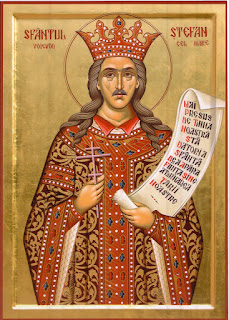
Saint Stephen the Great, prince of Moldova (+2 July 1504)


Saint Stephen the Great, known also as Stephen III Muşat (1457-1504) is one of the most celebrated saints in the modern Orthodoxy in Romania. Being a big hero of our history and big protector of the Church, ther was decided in 1992 to proclaim his saintness, being celebrated on 2nd July, in the day of his passing away.
His human qualities, as a good politician, strategist and diplomat, his actions in order to protect the integrity of his country, and his cultural sensibility caused a big admiration in Moldova and in the whole Europe, and thanks to the popular tradition, was transformed into a legendary hero. Moreover, Pope Sixtus IV called him Athleta Christi (athlete of Christ) and the people composed the ballad: ”Stefan Vodă (Prince), the great Lord, has no equal into the world but only the proudly sun”.
There is quite controversial to speak about a saint like Stephen the Great, and the public media brought a lot of arguments against his saintness. In this way, there is a problem to which the modern Christians should answer: how should we define the saintness and which man/woman can be proclaimed as a saint? But to this question we will answer later. Now, we should expose shortly the life of such a wonderful man for the political and Christian history of Romania.
Stephen the Great was born sometimes around 1430 in the village of Borzeşti, being the son of the Voivode Bogdan II Muşat of Moldova (1449-1451) and Lady Oltea, a noblewoman in the „Lowlands” of Moldova, from the family of Basarab, the rulers in Wallachia in that time. His ancestry is, by following, a noble one. His ancestor, Bogdan I founded the principate of Moldova at the end of the 14th century, and the Family of Muşat was connected by marriages with a lot of kings’ families from the whole Europe.
The young boy Stephen grew up far away from the voivodal Court from the capital city of Suceava. Probably he had some others brothers from his father’s marriages, thing that is quite unclear. Anyway, in 1451 his Uncle, Petru Aron, killed his father during a feast in Reuseni and becomes the new voivode of Moldova. In the same time, Petru Aron signs the first treaty with the ottoman Turks, so that Moldova becomes for the first time a vassal state of the Otoman empire.
Petru Aron tried to kill all the pretenders of the Throne, only Stephen escapes and run in Wallachia, to his cousin, Voivode Vlad III (well known in the western literature as Dracula). Later, in 1457 Sephen comes back with military enforcements from Vlad and sieges in the battle of Doljeşti, near Suceava. Since then, he becomes the new voivode of Moldova, ruling for about 47 years. He is unctioned as voivode, after the Byzantine ritual of consecrating the emperors, by the metropolitan Teoctist of Moldova. This is the longest reign in the whole history of Romania, excepting King Carol I (1866-1914), who is the exponent of the modernization of Romania.

Internal Politics

Stephen the Great changed the internal politics since the beginnings. He restraints the rights of the noble families, even punishing many of them to death. One of the preferred punishments in the Middle Ages was the impaling, and Stephen doesn’t make any exception from that rule. This thing will be controversial for the judging his saintness.
Anyway, we must understand his way of ruling in the mentality of the Middle Ages, which was not such humanistic in the way we understand today.
The local tradition tells that Stephen was confessing to an ascetical father from the Carpathian Mountains, known as Daniil Sihastrul (“The Hesyhcast” + 1497, also a saint), who counseled him not only in the spiritual, but also in his political actions.
The political situation of Moldova was very difficult, being situated in the sphere of influence of three great powers: the Ottoman Empire, who conquered under Mehmet II the Constantinople in 1453, the Kingdom of Hungary, ruled by Matthias Corvinus, and the Kingdom of Poland, ruled by Casimir IV. So, the political purpose of Stephen was to maintain the equilibrium between them and also to remain independent, as much as possible. That situation was but very difficult, and he was obliged to bear about 50 wars against those kingdoms and also against the Tatars who came quite often, destroying everything.
Stephen replaced all the noblemen who had another interest than protecting the country. Sometimes, after a battle, he named as noblemen some peasants, and punished the traitors. Also he was interested in building strong fortresses at the borders of the country, which proved to be very important in the later politics.

Building Churches

Stephen opened an interesting tradition, so after every battle he was building a church or a monastery, even if winning or losing it. His mentality was, that even in the battle against the enemies, killing the invaders is still a sin, so he wanted to build a church for the souls of the dead soldiers, Moldavians or enemies. Also, after all the battles he was fasting for a period and he obliged also his soldiers to fast, in order to be cleaned by the sin of killing.
Between the 44 documentary attested churches built by his command, there is worthy to mention the reconstruction of Neamţ Monastery, an important cultural centre for the whole history of Romanians, the Voroneţ Monastery, known also as “The Oriental Sixine Chapel”, because of the beautiful painting and the well-known scene of the Last Judgement, and Putna Monastery, where he was buried. This last one is very important, because at the end of the 19th century here started the actions of the Romanian Upraising from the Austrian-Hungarian Empire. So, Putna and the grave of Stephen the Great were symbols for the independence of the nation.


External politics

Stephen loved very much the culture and not only the Eastern one. At his court were poets, doctors and literate men from the Western countries, and he corresponded through letters with many rulers from the West. After the big battle of Vaslui (1475) where he won against Mehmet II, the same who conquered the Constantinople, His Holiness, Pope Sixtus VI named him Athleta Christi, and thought about the possibility to open a new battle against the Turks. Anyway, the plan never realized. In the next year, 1476, Stephen found himself alone against a big Turkish army and looses. He was almost to run away from the country, because none from the Western Kingdoms helped him, but after the advice of the monk Daniil, he starts the war again. In the end, he would be obliged to make peace with the Turks, paying an annual tribute in money and different materials. Another fights sent away Matthias Corvinus (Baia, 1467) and John Albert of Poland (Codrii Cosminului, 1497), establishing the independence of the country against Hungary and Poland.
After a glorious kingship, Stephen died on 2nd of July 1504. The funerary cortege went from the capital of Suceava to the Monastery of Putna (about 70 km) and the chronicles registered that a lot of people came to the funeral as crying after their own father. Interesting to say, that after the popular television contest, known as “Mari Români” (The greater Romanians), which also happened in some other countries, Stephen the Great was voted the Biggest Romanian from all the times, being followed by the King Carol I (1866-1914).

What about his sainthood?

This question came and still comes today in our media and press. Stephen was quite harsh with his enemies. Furthermore, he had three wives and many other illegal adventures. As an example, his illegitimate son, Petru Rareş is the most known son he had, and also voivod of Moldova, after his official brother, Bogdan III (1504-1517), because he was promoted in this position by the Turks, through his intelligence and money (1527-38 and 41-46).
Being saint or hero, these are two different things, but his canonization was not only a nationalistic business of the modern Orthodox Church in Romania. The first reason of being a saint, is that of protecting the Church in Moldova and helping it. Stephen is well known also by helping the monasteries from the Mount Athos, who were at that time in a very difficult financial situation, and in danger to be sieged by the Turks. Of course, financing the Church doesn’t mean automatically the saintness. But Stephen is known through the contemporary chronicles as a very faithful voivode, who was respecting all the Church traditions, such fasting, praying, helping the poor and the widows and so on.
The second argument of being a saint is, that he was a very just voivode, a strong fighter against corruption and lies, strongly practiced in the Middle Ages. But not only his justness was the quality of the voivode. He was a very modest man, living in a modest home, and exercising the virtue of humility in front of the priests, monks and other men and women of God. We mentioned already his humble attitude after a war, fasting and praying for the dead soldiers, equally if his own, or the enemies.
The second argument, quite unknown since a few years, is the way he died. It is well known that he crowned his own son even before his death. In the Middle Ages, the laws in Moldova stated that they cannot be two voivodes simultaneously, so probably he entered in the monastical status. Eve if that was not confirmed by the chronicles, in the middle of the 18th century his grave was opened, and his Relics were found in the Porphyry robe, usual for the voivodes. Still he had no coffin, but his body stand on 13 iron bars, and under his head was found a brick. Those things can attest the fact that Stephen died as a monk, such as also some of his successors, like Alexandru Lăpuşneanul (1552-61 and 64-68).
Finally, for the Eastern Christianity, the process of canonization differs from the western one. The necessity of the relics, or of the miracles is not obligatory. Instead of it, the popular veneration of a saint and the orthodoxy of his faith are obligatory, in order to proclaim him officially. That was also the old practice of canonization, because in the first centuries there’s totally unknown any process of making someone as a saint.
In this way, the Holy Synod of the Romanian Orthodox Church proclaimed him as a saint on 2nd July 1992, during a big feast at the Monastery of Putna. The celebration of 500 years after his death, in 2004, was a National Holiday.

Troparion of the Saint

“Fearless defender of the faith and of our country, great founder of sanctuaries, O, Prince Stephen, pray Christ the God to deliver us from the troubles and needs!”